AI agent development · § 00
AI agents that do the work, not just the demo.
We design and build agents and multi-agent systems that run in production, call real tools, and stay under human control. We built our own agent platform, so this is not a first attempt.
- Agent + multi-agent systems
- MCP tool integration
- Human-in-the-loop by default
Why most agent projects stall
A demo agent is easy. A production agent is a different job.
The gap between a clever prototype and something you can trust with real work is where most agent projects die. These are the failures we build against.
-
F-01
Loops that never finish
An agent with no guardrails burns tokens, retries forever, or wanders off task. Without hard stops it becomes a liability, not a worker.
-
F-02
No real tools
A chatbot that can only talk is not an agent. The value is in acting on your systems, and that means wiring in tools, APIs, and data safely.
-
F-03
No human in the loop
Handing an agent write access with no approval step is how you get a bad email sent to every customer. Control has to be designed in from the start.
-
F-04
Right most of the time
An agent that works in nine cases and quietly fails the tenth is worse than no agent. Production means handling the edge cases, not just the happy path.
-
F-05
No way to see what happened
When an agent makes a call you disagree with, you need the trace. Most prototypes have no logging, so you cannot debug or improve them.
-
F-06
A prototype you cannot own
A notebook that runs on one laptop is not a system. You need deployable, documented code you can run and extend without the people who wrote it.
How we build agents
From objective to a system you can run.
A short, visible loop. You see the agent working against your real tasks early, which is the only reliable way to catch a wrong approach before it is expensive.
-
Scope the job
We define what the agent should decide, what it can touch, and where a human signs off. That boundary is the design, not an afterthought.
-
Wire the tools
We connect the agent to your systems through typed tools and MCP servers, so it acts on real data instead of guessing.
-
Harden the loop
Stopping conditions, retries, evals, and logging. We run the agent against real cases until its failures are known and bounded.
-
Ship and hand over
Deployed, documented, and observable. You own the code and can see every decision the agent makes.
Built on real experience
We build agents because we run an agent platform.
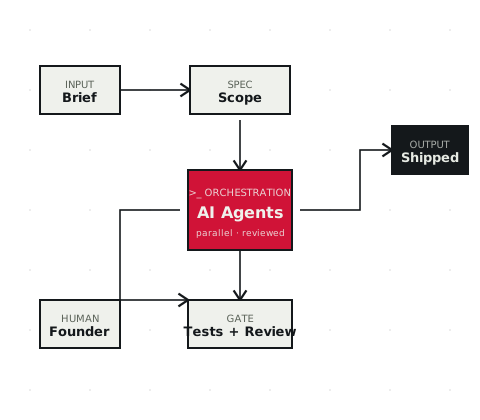
Vibehub is our own AI-agent orchestration platform. We use it to run parallel agents against real engineering work every day, which means the patterns we bring to your build are ones we depend on ourselves, not slideware.
- Single and multi-agent systems
One focused agent, or a set of specialised agents coordinating on a larger task.
- MCP-native tool access
We expose your systems to agents through Model Context Protocol servers, the same way we do internally.
- Guardrails and evals
Approval gates, spend limits, and test suites so behaviour stays inside the lines you set.
What you get
An agent that earns its place.
Not a demo that impresses once. A system that does a defined job reliably, with the controls to trust it.
-
B-01
Scoped autonomy
The agent acts inside clear limits you set and approve, so more work moves without more risk.
-
B-02
Real integrations
Connected to the tools and data your work actually depends on, not a sandbox.
-
B-03
Code you own
Documented, deployable, and readable. No lock-in to us or to a no-code black box.
-
B-04
Full traceability
Every decision and tool call is logged, so you can audit, debug, and improve behaviour.
-
B-05
Fast iteration
AI-accelerated delivery means you see the agent working against your cases in days, not months.
-
B-06
A person who built it
You work directly with the people who designed the system, not an account manager relaying tickets.
Agent development sits at the centre of our AI-build work. An agent is most useful when it can reach the rest of your stack, so most builds pull in AI integration to connect models to your systems and MCP development to expose those systems as tools an agent can call safely. When the goal is to take a repetitive process off people’s plates entirely, that overlaps with AI automation.
The clearest proof that we can do this is that we did it for ourselves. Vibehub is our AI-agent orchestration platform, and it runs the same agent and Model Context Protocol patterns we bring to client work.
AI-build cluster
Explore the rest of the AI-build work
Agents rarely stand alone. They connect to your systems, automate real processes, and expose tools through MCP.
Questions
Frequently asked
- An agent is software that takes a goal, decides on the steps to reach it, and calls tools or APIs to act, rather than just returning text. In production that means it also has stopping conditions, logging, and a human approval point for anything sensitive.
- Start with the simplest thing that solves the problem, which is usually a single well-scoped agent. Multi-agent systems earn their complexity when a task genuinely splits into separate roles that benefit from running in parallel. We do not add agents for their own sake.
- We are model and framework agnostic and pick based on the job, cost, and your existing stack. We build tool access on the Model Context Protocol so the agent is not locked to one provider. If you want the deeper version, our guide to AI agent development frameworks covers the trade-offs.
- Guardrails are part of the design, not a patch. That means bounded autonomy, approval gates before irreversible actions, spend and rate limits, and evaluation suites that test the agent against real edge cases before it goes live.
- We built and run Vibehub, our own AI-agent orchestration platform, and use it daily. The agent and MCP patterns we bring to your project are ones we rely on ourselves.
- Yes, fully. You get documented, deployable code you can read, run, and extend without us. There is no retainer trap and no proprietary runtime you are stuck with.
Have a job an agent should be doing?
Tell us the task and the systems it touches. You will talk to the person who will build it.