AI integration services · § 00
Get AI into the software you already run.
Most companies do not need a new AI product. They need an LLM wired into the systems they already have, safely and with a way to control cost. That is the job we do.
- LLM integration
- Retrieval over your data
- Provider-agnostic
Where AI integration goes wrong
The demo worked. Then it met your real systems.
Calling an API in a notebook is easy. Making it reliable, affordable, and safe inside a real product is where teams get stuck. These are the problems we build around.
-
F-01
Hardcoded to one provider
A prototype glued to a single vendor breaks when that vendor changes pricing, rate limits, or a model. You need a layer that lets you switch.
-
F-02
The model does not know your data
A generic model answers in generalities. The value is in grounding it on your documents, records, and rules, which is a retrieval problem, not a prompt.
-
F-03
Costs that surprise you
Without caching, routing, and limits, token spend scales in ways nobody budgeted for. Cost control has to be built in, not bolted on later.
-
F-04
Data going where it should not
Sending customer or internal data to a model without controls is a real risk. Integration means deciding what leaves your boundary, and enforcing it.
-
F-05
Slow, brittle calls
No fallback, no retries, no streaming. When the provider is slow or down, the whole feature is down with it.
-
F-06
No way to measure quality
If you cannot tell whether the AI output is good, you cannot ship it responsibly. You need evaluation, not vibes.
How we integrate
From API key to a feature you can trust.
A short loop that puts a working, grounded integration in front of you early, so we tune quality and cost against your real data instead of a sample.
-
Map the use case
We pin down exactly what the AI should do, what data it needs, and what must never leave your systems.
-
Build the layer
A provider-agnostic gateway with auth, caching, retries, and fallback, plus retrieval over your own data where it is needed.
-
Tune quality and cost
Evaluation against real cases, prompt and retrieval tuning, and spend controls until the output is good and the bill is predictable.
-
Ship and hand over
Deployed inside your stack, documented, and observable. You own it and can swap providers without a rewrite.
Built on real experience
We integrate models into products we run ourselves.
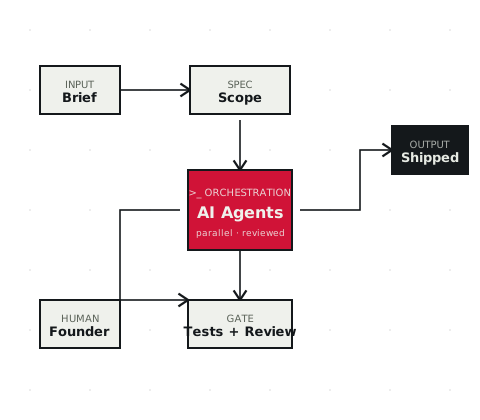
Vibehub, our AI-agent orchestration platform, is a working LLM integration in production. We deal with provider fallback, cost control, and grounding on real data as part of our own operations, so the patterns we bring to your systems are tested, not theoretical.
- Provider-agnostic gateway
One layer between your app and the models, so you can route, cache, and switch providers without touching your product code.
- Retrieval over your data
Grounding the model on your documents and records so answers are specific and accurate, not generic.
- Cost and data controls
Spend limits, caching, and clear boundaries on what data can leave your systems.
What you get
AI that fits your stack.
Not a bolt-on product you have to work around. An integration that lives inside the systems your team already uses.
-
B-01
No vendor lock-in
A layer that lets you change models and providers as prices and capabilities move, without a rewrite.
-
B-02
Grounded answers
Retrieval over your own data so the model responds with your facts, not the internet's average.
-
B-03
Predictable cost
Caching, routing, and limits that keep token spend inside a number you set.
-
B-04
Data you control
Clear rules on what leaves your boundary, enforced in code.
-
B-05
Code you own
Documented and deployable inside your stack. No proprietary runtime to depend on.
-
B-06
Straight talk on AI
Honest LLM consulting on where AI pays off for you and where it does not, before anyone writes code.
AI integration is the base layer of our AI-build work. Once a model is wired into your systems safely, the next steps get much shorter: AI agents that act on that connection, AI automation that runs whole processes through it, and MCP development to expose your systems as tools an agent can call.
If you are still deciding whether AI belongs in a given workflow at all, start with an AI readiness audit for a vendor-neutral read before any build. And for proof that we run this in production, not just for clients, see Vibehub.
AI-build cluster
Explore the rest of the AI-build work
Integration is the foundation. On top of it we build agents that act, automations that run, and MCP servers that expose your systems as tools.
Questions
Frequently asked
- It is the work of taking an AI capability, usually an LLM, and making it a reliable part of software you already run. That covers the connection layer, grounding the model on your data, controlling cost, enforcing data boundaries, and measuring output quality. The model call is the easy part. Everything around it is the integration.
- No. We build a provider-agnostic layer so you can route between models and switch vendors as pricing and capabilities change. Locking a product to a single provider is a risk we design out from the start.
- Yes. Grounding a model on your documents and records is a retrieval problem, and it is usually where the real value is. We build that so the AI answers with your facts, under rules about what data can and cannot leave your systems.
- Both, in that order. We start with an honest read on where AI fits and where it does not, then we build the integration. If you only want the assessment first, our AI readiness audit is the smaller way in.
- Caching, request routing, and hard spend limits, tuned against your real usage. Cost control is part of the build, not something you discover on the first invoice.
- Yes, fully. You get documented, deployable code that lives in your stack, with no proprietary runtime you are tied to.
Want AI inside the software you already run?
Tell us what you use and what you want it to do. You will talk to the person who will build the integration.