MVP development · § 00
An MVP you can ship, not a prototype you throw away.
We build a first version that is small on purpose but real underneath. Deployed, tested, and built on code you own, so the thing that proves your idea is also the thing you keep building on.
- Scoped to the core
- Production from day one
- Code you own
Why most MVPs go wrong
The two ways a first build fails.
An MVP fails when it does too much or when it is built as a demo. Both waste the same months. These are the traps we scope against before a line of code is written.
-
F-01
Building everything
A first version with settings, roles, billing tiers, and an admin panel is not an MVP. It is a slow, expensive way to learn the same thing a smaller build would have told you in weeks.
-
F-02
A demo that cannot grow
A no-code mock or a throwaway prototype answers one question and then blocks you. When it works, you rebuild from scratch, and the time you saved up front is gone.
-
F-03
No clear thing to prove
If the build is not pointed at one question, you cannot tell whether it succeeded. We define what the MVP has to prove before we decide what goes in it.
-
F-04
Months before anyone uses it
The longer a first version stays in the workshop, the more it drifts from what users actually want. The point of an MVP is to get in front of real people quickly.
-
F-05
A codebase you cannot hand off
Plenty of MVPs are built to be disposable, so they are undocumented and tangled. When you hire a team, they inherit a mess and quietly start over.
-
F-06
No way to read the result
Without basic analytics and logging, launch tells you nothing. You need to see what users do, not just that the thing is live.
How we build an MVP
From one clear question to a live product.
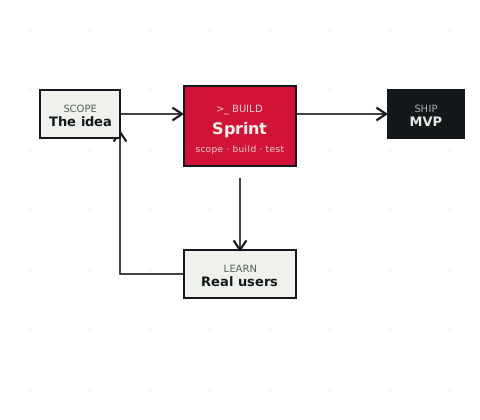
A short, visible loop. You see working software against your real use case early, which is the only reliable way to catch a wrong turn before it costs a month.
-
Define what it must prove
We agree on the one thing this build exists to test, and cut everything that does not serve it. That scope decision is the most valuable work we do.
-
Build the core
We build the smallest real version of the core loop, deployed and testable, on a stack that can grow rather than a mock that has to be thrown away.
-
Put it in front of users
We ship it to real people with the logging and analytics to see what they actually do, so the result is evidence, not opinion.
-
Iterate or hand over
You get documented, deployable code. Keep going with us on the next iteration, or take it to your own team without friction.
Proof it holds up
We built a fintech marketplace that runs in production.
ROSHI is a loan marketplace we built that grew into one of Singapore's top three loan comparison marketplaces. It started as a first version pointed at one question and grew into a system real users depend on. That is the difference between an MVP and a prototype, and it is the standard we build your first version to.
- Production from day one
Deployed, monitored, and secure. The MVP is a real product, just a small one, not a sandbox that breaks under a real user.
- A stack that grows
We build on foundations that scale into a full product, so success does not mean a rewrite.
- Instrumented to learn
Analytics and logging from launch, so the first version answers your question with data.
What you get
A first version worth building on.
Not a mock that impresses in a meeting. A live product that answers your question and becomes the base for everything after it.
-
B-01
Scoped to the core
Only what is needed to prove the idea, so you spend weeks learning what a full build would spend months on.
-
B-02
Live and usable
Deployed for real users, not a click-through demo. The result is behaviour you can measure, not guesses.
-
B-03
Code you own
Documented, deployable, and readable. No lock-in to us and no no-code black box you cannot extend.
-
B-04
Weeks, not quarters
AI-accelerated delivery gets a real first version in front of users fast, while the idea is still fresh.
-
B-05
Built to extend
The MVP is the foundation of the product, not a detour you abandon when it works.
-
B-06
A founder who built one
You work with the person who built a production marketplace, not an account manager relaying tickets.
MVP development is the front door to our delivery work. The hard part is not the code, it is deciding what to leave out, and that scope call is where we spend our first energy. When a build needs technical direction beyond the first version, that shades into fractional CTO work. When the question is whether AI belongs in the product at all, an AI readiness audit answers it before you commit a budget.
The clearest proof that we build first versions that last is ROSHI, a loan marketplace we built that is now one of Singapore’s top three loan comparison marketplaces. It started small and pointed at one question, then grew into a system real users depend on.
Delivery cluster
The rest of the delivery work
An MVP is the first move. Some teams also need technical leadership to steer it, or an honest read on where AI fits before they build.
Questions
Frequently asked
- The smallest real version of your product that answers one important question, usually whether people will use and pay for the core thing. It is deployed and usable, not a slide deck or a click-through mock. It leaves out everything that does not serve that first question.
- A prototype is built to be discarded, so it is often a no-code mock or undocumented code that blocks you the moment it succeeds. We build the MVP as a small but real product on a stack that grows, so a good result means you keep building, not that you start over.
- It depends on the core loop, but AI-accelerated delivery means weeks rather than quarters for most first versions. The scope conversation up front is what keeps it short. The more ruthlessly we cut to the one thing that matters, the faster you get real evidence.
- Yes, fully. You get documented, deployable code you can read, run, and extend without us. There is no proprietary runtime you are locked into and no retainer required to keep the lights on.
- That is the point. We build on foundations that scale rather than a disposable mock, so the MVP becomes the base of the real product. ROSHI began as a scoped first version and grew into one of Singapore's top three loan comparison marketplaces.
- We can assess what you have and decide honestly whether to build on it or rebuild the core properly. If a quick mock got you a first signal, that is useful. We will tell you plainly whether it is a foundation or a dead end.
Have an idea that needs a first real version?
Tell us the one thing it has to prove. You will talk to the person who will build it.